
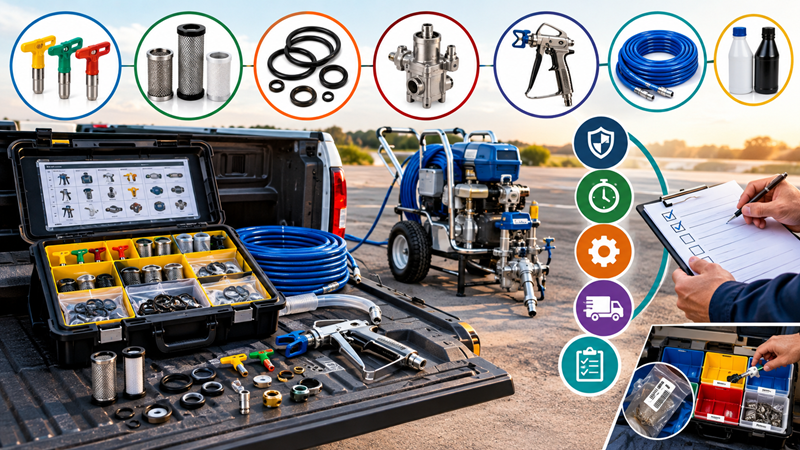
Spare parts have an image problem. They sit on a shelf, they cost money and most of the time they are never used. Then a pump packing fails on a Friday afternoon and the same part is suddenly the most valuable item in the truck.
The task is to carry the right spares, not as many as possible. For airless coating and striping equipment, a small set of inexpensive wear parts covers most of the stoppages that happen in the field. This guide explains how to decide what to carry, how many to carry and how to keep the kit organized, using the failure patterns described in sprayer manufacturers’ troubleshooting tables.
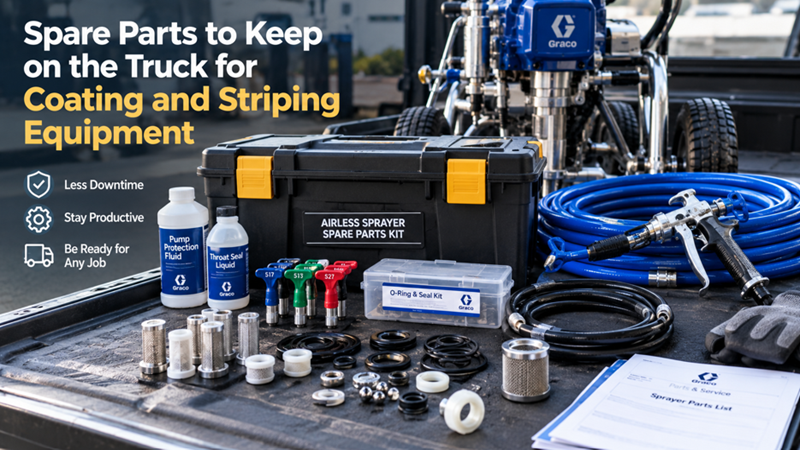 Key takeaways
- Stock by consequence, not by price: carry the parts that are cheap, fail often and stop the job when they do.
- Five categories cover most stoppages: tips, filters, o-rings and seals, a pump packing kit and a spare hose.
- Match every spare to a specific machine by model and pump, and label it.
- Replace what you use the same week so the kit is always complete.
- Bulky parts, such as hoses, take longer to ship, so keep one in the truck.
Think in terms of consequence
A simple way to decide what to stock is to ask three questions about each part.
- How likely is it to fail? Tips, filters and o-rings wear in normal use. Pump rods and motors usually do not.
- What happens when it does? If the crew stops, the part is critical. If it can wait until the end of the day, it is not.
- How long does it take to get another? A part you can pick up at a counter is less urgent than one that must be ordered and shipped.
Parts that are likely to fail, stop the job and take days to replace belong in the truck. Everything else can be ordered when needed.
What fails on airless coating equipment
Airless equipment, whether it is a sprayer on a cart or a striping machine with an airless pump, has the same basic parts: a pump that pressurizes the coating, filters that protect the tip, a gun with a needle and seat, a hose and a tip. Manufacturers’ troubleshooting tables for these machines repeatedly list a short set of causes for common problems:
- Low pressure or poor pattern: a worn tip, a clogged filter, a hose that is too long or damaged, then pump valves and packings.
- Paint leaking at the pump: worn throat packings.
- Pump will not prime: a clogged inlet strainer, an air leak on the suction side or a worn intake valve.
- Gun leaks or will not shut off: worn gun seals, needle or seat.
That is a list of consumables, and it points directly to a spares list.
A spares list by system
| System | Spare to carry | Why | Suggested starting point |
| Tip | Spray tips in the sizes you use | Tips wear, and a worn tip causes tails and a narrow fan | Two per size in regular use |
| Filters | Gun filters, manifold or outlet filter, inlet strainer | They clog on long days and tear with use | Three or four gun filters, one of each other type |
| Seals | O-ring and seal set for the filters, gun and fittings | Rubber parts harden with heat and age | One set per machine |
| Pump | Packing or repair kit for each pump model | Worn packings cause leaks and low pressure | One kit per pump model |
| Gun | Gun repair kit (seals, needle and seat) | Prevents leaks and a gun that will not shut off | One per gun type |
| Hose | Whip hose and a spare section of hose | A damaged hose stops the job and can be unsafe | One whip and one standard length |
| Fluids | Throat seal liquid, pump protection fluid | Protect the pump during use and storage | One bottle of each |
The final column is a suggested starting point, not a rule. A rental fleet that runs machines every day will carry more than a contractor who sprays two days a week. Adjust the quantities to how fast you use parts and how far you are from a supplier.
How to build your list
- List every machine you run, with the model, series and pump model from the ID plate.
- Pull the parts list for each machine from the manufacturer’s manual. Mark the wear items: tips, filters, packings, o-rings, seals, needle and seat.
- Group the shared parts. Many machines share filters, tips and gun parts, which means one spare may cover several machines.
- Decide the quantity for each part using the starting points above and your own history.
- Order the parts by part number, and confirm that each one matches your model before you buy.
- Label everything with the part number and the machines it fits.
If you work with Graco-compatible machines, pump, gun, filter and hose parts for Graco airless sprayers are organized by system and show the OEM number each part replaces, which makes the matching step quicker. The same approach works with any brand: use the manufacturer’s parts list as the master and cross-check by number.
Organize it so you can find things at 6 a.m.
A spares kit that cannot be found in a hurry is not much use. A few habits help.
- Use a single toolbox or case with labeled bins, one per system.
- Keep a printed list inside the lid with part numbers and quantities, so you can see at a glance what is missing.
- Bag and label small parts. An o-ring set loses its identity quickly when it is loose.
- Store rubber parts out of the sun and heat. O-rings, hoses and seals age faster when they are left in a hot truck.
- Keep the kit with the machine if you run several rigs, so the spares always travel with the equipment they fit.
Replace what you use
A spares kit works only if it is kept complete. The simplest rule is: whatever you use, you reorder that week. Make it part of the end-of-day routine: if you changed a filter or a tip, write it on the list. Once a month, check the list against the box and order what is missing.
Lead time matters here. At eRepairCenter, for example, orders placed by 12:00 PM Eastern are processed the same business day, and delivery typically takes three to four business days by UPS or USPS, which is an estimate that varies with location and weather. Hoses are heavy and bulky, so they ship on a custom quote. If your supplier works similarly, it is a good reason to keep a spare hose in the truck instead of ordering one after a failure.
New, aftermarket or used: what to carry
For wear parts, there are three sources, and each has a place.
- Original manufacturer parts are the safe choice if the machine is under warranty. Manufacturers, including Graco, say their warranties exclude damage caused by substituting non-original parts, so ask before you repair a machine that is still covered.
- Aftermarket parts made to replace a named OEM number can reduce the cost of a spares kit for machines that are out of warranty. Look for listings that state the OEM number and are clear about what the part is.
- Used or surplus parts are sensible for non-wear items such as housings and covers. Wear parts such as packings and o-rings are better bought new. Used and surplus parts should state their condition.
A note on striping equipment
Many line-striping machines use an airless pump and gun, so the same categories of spares apply: tips, filters, packings, seals and hose. The details differ, because striping tips and guns are specific to the machine and the line width. Always build the list from your own manual and your own parts diagram, and note the tip sizes you use for each stripe width.
Frequently asked questions
What is the single most important spare for an airless sprayer?
There is no single part, but a gun filter and a spare tip handle the largest share of mid-job problems. After those, a packing kit for the pump is the part with the biggest consequence.
How often should I replace pump packings?
Manufacturers do not publish a fixed life in hours or gallons for packings. Replace them when the symptoms say so, such as paint at the packing nut or pressure that will not hold, and carry a kit so that the repair is a short one.
Do I need a different spares kit for each machine?
Only for the parts that are specific to the machine, such as the pump kit and the gun repair kit. Tips, filters and many fittings are shared, so one stock can serve several machines.
How do I make sure a spare will fit?
Use the model and series from the ID plate and the manufacturer’s parts list, then match the part by number. If the number is unclear or there are several versions, ask the supplier to confirm the fit before you order.
Three example kits
The right kit depends on how you work. These examples show how the same categories scale.
The solo painter with one machine
- Two spray tips in the main size and one in a second size
- Three gun filters and one inlet strainer
- One o-ring and seal set
- One pump packing kit and one gun repair kit
- One short whip hose
The crew with three rigs
Carry the solo kit, then add a second set of tips and filters (tips and filters are shared across most rigs), a packing kit for each different pump model and one spare section of main hose. Keep the three machine models and pump numbers on a card in the toolbox.
The rental fleet
Fleets turn machines around between customers, so the priority is speed. Keep a full set of wear parts for each model on a shelf, replace tips, filters and gun seals as part of every return inspection and keep the pump kits where the technician can reach them without searching. Track what you use, because the fleet’s own history is a better guide to quantities than any rule of thumb.
Shelf life and inventory habits
Rubber and plastic parts age even when they are not used. Store o-rings, seals and hoses in a cool, dry place, away from sunlight and solvents, and rotate them so the oldest are used first. Check the box at the start of every season: look for hardened o-rings, cracked hose and any bag that has been opened. A spare that has aged out is no use when you need it.
The short version
Carry the cheap, fast-wearing parts: tips, filters, o-rings, a pump kit, a gun kit and a hose. Label them, keep the list current and replace what you use. A spares kit of this kind is inexpensive compared with the cost of one lost day, and it turns most field failures into a short delay.
About the author
The eRepairCenter parts team helps painters, contractors and maintenance crews identify and replace worn parts on airless paint sprayers. eRepairCenter is a Houston, Texas supplier of aftermarket, used and surplus replacement parts and an authorized Bedford Precision distributor, shipping across the United States.