
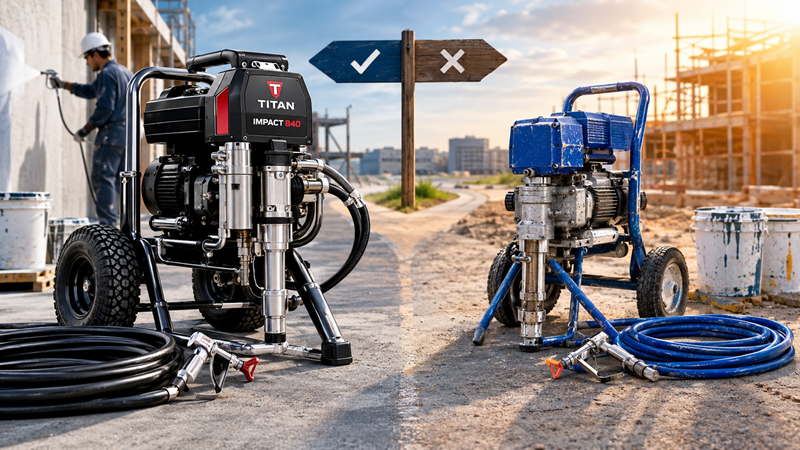
Contractors looking for a heavy-duty airless sprayer often face a tough choice during their buying research. On one side sits the Titan Impact 840, a proven industrial workhorse with a price to match. On the other side sits a cheaper alternative that promises similar output for less money up front. Choosing the right sprayer means weighing what you might sacrifice with a cheaper option against the money you save upfront.
What Makes the Impact 840 an Industrial Machine
The 840 is built for contractors spraying large volumes of material on commercial jobs, often with thicker coatings like block filler, elastomeric roof coatings, and heavy primers that put real strain on a pump. The fluid section is engineered to handle that abuse over thousands of cycles rather than hundreds, which is the core difference between an industrial sprayer and a prosumer one, even when the spec sheets look similar side by side.
The main assembly on the 840 houses a motor and drive system rated for continuous duty rather than intermittent use. That distinction matters enormously if you are running the machine for hours at a stretch on a commercial job site, because a motor that is only rated for intermittent duty will overheat and shorten its own lifespan when pushed into continuous service, regardless of how good the fluid section is. This is also where a lot of budget machines quietly cut corners, using a smaller motor housed in a case that looks similar to a true industrial unit.
The Real Cost of a Lower-Priced Alternative
Cheaper industrial-looking sprayers often cut costs in places that are not obvious from a spec sheet or a showroom floor. The motor windings may be lighter gauge, the fluid section housing may be a softer alloy that wears faster under abrasive coatings, and the packing material may not be rated for the same chemical resistance as what Titan uses. None of that shows up until the machine has a few hundred hours on it, at which point the repair bills start eating into whatever you saved on the purchase price.
Parts availability is the other cost that rarely gets factored in up front. When a component fails on a job site, the difference between a same-day part and a two-week backorder is real money in lost production time. An established platform with a deep parts catalog and readily available fluid section assemblies tends to get you back to work faster than a newer or less common brand, even if that brand’s initial price seemed more attractive at first glance. A complete replacement fluid section for the 840, while a meaningful expense, is still a fraction of the cost of a full pump replacement on a machine that was never designed to be serviced in the first place.
Questions to Ask Before You Buy the Cheaper Option
Before choosing a lower-cost alternative over the 840, it is worth asking a few direct questions. How is the fluid section built, and is it field serviceable, or does it require a full pump replacement when it wears out? What is the actual parts lead time from the manufacturer or distributor, not just the advertised shipping window? And has the machine been proven in the specific coatings you spray most, or is it being marketed primarily on price and general specs?
If the answers to those questions are vague or the seller cannot point you to a distributor with parts on hand, that is a meaningful signal about what ownership will actually look like a year or two down the road, regardless of how attractive the initial price is. It is also helpful to ask local contractors which sprayers they use and why, as their hands-on experience with similar coatings can be more valuable than manufacturer claims. reliable than any manufacturer’s marketing material.
What a Season of Heavy Use Actually Reveals
The real test of any industrial sprayer is not the first month; it is the accumulated wear after a full season of commercial jobs. Machines that looked identical on a showroom floor often diverge sharply by the time they have a hundred or more working days behind them. The 840’s reputation in the trade was built on exactly that kind of accumulated evidence, from contractors who ran it hard and reported back on what actually failed, and how often, and how expensive the fix turned out to be.
That track record is worth something that a newer, unproven alternative simply cannot offer yet, regardless of how good its specifications look on paper today. A proven platform with a known failure pattern and a known parts supply chain removes a lot of the guesswork from an expensive equipment decision.
When a More Affordable Sprayer Makes Sense
To be fair, not every job justifies an 840. If you are running occasional commercial work mixed with mostly residential jobs, or if your volume simply does not call for continuous duty capacity, a lower cost alternative can be the smarter financial decision. Buying more machine than your workload requires ties up capital that could go toward other equipment or simply stay in the business.
The decision really comes down to how you use the machine, not which one has better specs in isolation. If you are spraying heavy coatings for hours at a time on commercial sites regularly, the 840’s build quality and parts ecosystem tend to justify the price difference within a year or two of steady use. If your workload is lighter or more occasional, that premium is harder to earn back, and a well built lower cost machine can serve you just as well.
Resale Value Reflects the Same Reputation
An often overlooked piece of the cost comparison is resale value. A well-maintained Impact 840 with documented service history retains meaningful value on the used equipment market, because buyers know the platform, trust its parts ecosystem, and can verify its condition against a known baseline. A lesser-known budget alternative typically has a much thinner resale market, partly because buyers are less certain what they are actually getting and partly because there is less established data on how that machine holds up over time.
If you ever plan to upgrade or change your equipment mix down the line, that difference in resale value effectively lowers the 840’s true cost of ownership even further, something a straight purchase price comparison completely misses.
Talking to Your Distributor Before You Decide
One resource a lot of buyers underuse is simply asking their parts distributor which machines actually generate the fewest support calls. A distributor who sells and services both premium and budget sprayers has direct visibility into failure rates that neither manufacturer’s marketing material nor a spec sheet will ever show you. That conversation, more than any brochure, often gives the clearest picture of which machine is likely to serve you well under your specific working conditions.
Protecting the Investment Either Way
Whichever machine you choose, the same maintenance discipline determines how long it actually lasts. Flush thoroughly after every job, replace filters before they clog, and address packing wear as soon as you notice pressure dropping rather than waiting for a complete failure. A well-maintained lower-cost machine will often outlast a neglected premium one, so the buying decision only tells half the story. How you run the machine day to day tells the rest.